
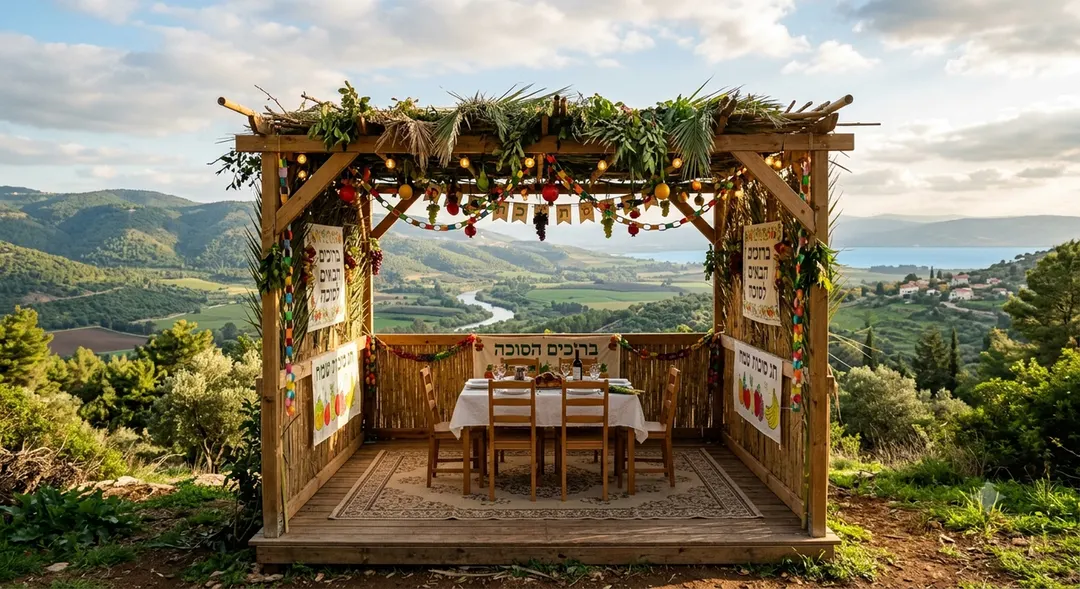
Sukkot abroad: building a sukkah that actually holds
A sukkah for twenty-four, in another country, in October, is a construction project with a fixed deadline. What that involves — and how to choose a property that can take one.
Families imagine the sukkah as the decorative part of a Sukkot abroad. It is the part with the longest lead time and the most ways to fail.
A structure that seats twenty-four, stands up to European weather in October, sits within halachic requirement and can be dressed to look like somewhere you want to eat every night for a week is not a purchase. It is a build, with a delivery date that cannot move.
Choose the property for the courtyard
The single decision that determines whether Sukkot works is made months earlier, when the property is selected.
What we look for: a flat, unobstructed area of the right size, with nothing overhanging it — no balcony, no tree canopy, no eave. Access wide enough to get materials in. Proximity to the kitchen, because carrying food a hundred metres in the rain for eight days is its own kind of chag. Power for lighting and heating. And shelter from the prevailing wind, which in Alsace or northern Italy in October is not a theoretical concern.
Many otherwise perfect houses fail on the overhang alone. We check it before anything is contracted.
The build
Structure sourced or fabricated, delivered and assembled several days ahead. Schach sourced locally — this varies enormously by region, and in some places it has to be arranged months in advance. Flooring, because a week on wet gravel is miserable. Lighting that works on a timer. Heating, which in early October in the Alps or Alsace is not optional in the evenings.
Then the weather contingency, which is the part most often skipped. What happens if it rains for two days? Where does the meal go? Is there a covered route from the kitchen? Deciding this in advance is the difference between a memorable chag and a scramble.
The kitchen runs in parallel
A Yom Tov operation for twenty-four across the full chag needs capacity, redundancy and a plan for the days when nothing can be switched on. Warming, blechs, urns, timers, and enough refrigerated storage to hold several days of prepared food at once.
This planning happens in September, so that October can be spent at the table.
Choose the region for the days in between
Chol hamoed is half the trip and it decides how the week is remembered.
Alsace works because the Jewish history is still standing in the villages, the wine route is beautiful in October, and the driving distances are short. New England works for the same structural reason in a different key: foliage, farms, short drives, and somewhere to be every day without anyone spending three hours in a car.
Pick the region for those days, then find the courtyard.