Portugal: a gem to explore
Why Portugal suits a private kosher family journey — Lisbon and the coast, the Douro, the Algarve, and a Jewish history that runs deeper than most visitors expect.
Portugal is the country families ask us about after they have already done Italy and Greece — and then, almost without exception, the one they want to return to. It is smaller, quieter and less expensive than its neighbours, the drives are short, the light is extraordinary from March to November, and it has a Jewish history that most visitors only discover once they are standing inside it.
It is also, for kosher travel, a country that rewards planning. That combination — easy to enjoy, demanding to provision — is exactly the kind of place we are built for.
The shape of a week
Portugal divides neatly into four regions, and a good week uses two of them rather than four.
Lisbon and the coast. A city you can actually walk with children, hills and all: tiled façades, viewpoints at the end of ordinary streets, the estuary opening out at the bottom of every hill. Sintra sits half an hour away in its own microclimate of palaces and forest. West and south of the city, Cascais, the Arrábida coast and Comporta offer long Atlantic beaches with almost none of the Mediterranean’s summer density.
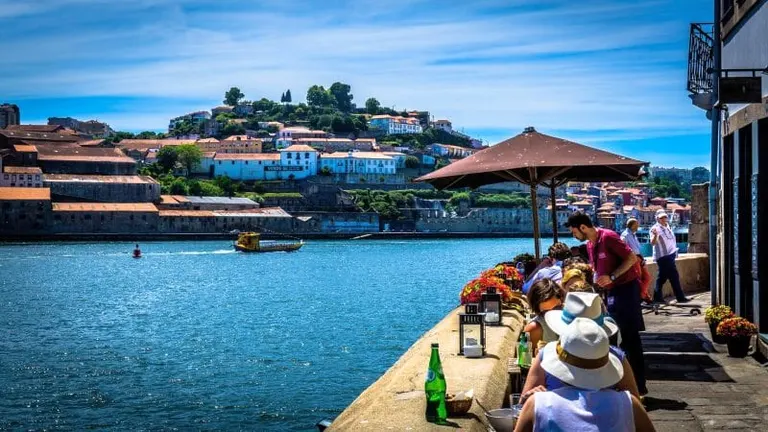
Porto and the Douro. The river is the point. Porto stacks itself up both banks, and an hour inland the Douro valley turns into terraced hillsides that have been shaped by hand for centuries — one of the most dramatic agricultural landscapes in Europe, and one of the quietest places we know to spend a Shabbat.
The Algarve. The reliable summer answer: cliffs, coves, warm water, and villa estates built for exactly this kind of week. Best in June or September, when the coast is still generous and the crowds have not arrived or have gone.
The Alentejo. Between the two, and overlooked. Cork oak, wheat, whitewashed hill towns, Évora’s Roman temple, and estates set in the middle of nothing at all. For a family that wants space and slowness, this is the region we suggest first.
A history worth travelling for
Portuguese Jewish history is not a footnote here. Tomar holds one of the oldest surviving synagogue buildings in the country, from the fifteenth century, now a small museum. In Belmonte, high in the interior, a community of descendants of forced converts practised in secret for generations before returning openly to Jewish life in the twentieth century — its synagogue and museum are among the more affecting hours you can spend in Europe. Lisbon’s Shaare Tikva, from 1904, and Porto’s Kadoorie Mekor Haim, from 1938, both stand and both hold services.
We plan these visits with an educator who can hold the room for adults and children at once, and we plan them around the day rather than crammed into a morning. A single well-guided site tends to matter more than three rushed ones.
The kosher question, answered honestly
Portugal has small Jewish communities and correspondingly limited kosher retail. You will not provision a family week from what is on the shelf, and outside a handful of places you should not plan to eat out.
That is not a reason to avoid Portugal. It is the reason our weeks there are built the way they are: a kosher kitchen established at the property, a chef and team on site, provisioning routed from where the supply actually is, and a standard agreed with the family before a single order is placed. Once that is in place, the constraint disappears — the table becomes the best part of the week rather than its logistical problem. Fish comes off the Atlantic that morning. Produce comes from markets that have not changed much in fifty years. The cooking is simple, and it is very good.
When to go
May, June and September are the best weeks of the year here — warm without the August peak, and long in the evening. July and August work well on the Algarve coast and in the Alentejo interior if the property has water and shade; Lisbon in high summer is hot, and better taken in short mornings. October is still generous in the south, and the Douro is at its most beautiful during harvest.
Who it suits
Portugal suits multi-generational groups, families with children old enough to walk a city, and anyone who wants a week with real substance to it that is not, in the end, exhausting. It suits people who like landscape and food more than nightlife. And it suits families who have travelled enough to know that the quality of a week rests on how well it was arranged, not on how much was packed into it.
If Portugal is on your list, tell us who is travelling and roughly when, and we will tell you honestly which two regions to spend the week in — and which to save for the next one.