Destinations / Morocco
Morocco,
and its Jewish century
Jewish history, cuisine, riads, villas, desert experiences and private cultural journeys — in a country where the Jewish story is unusually present and unusually well kept.
Why here
Morocco is the rare heritage destination that is also a genuinely great holiday. The mellahs and the cemeteries are there, and so are the mountains, the coast, the desert and one of the world's serious cuisines. Families come for the history and stay for the rest of it.
It is also a country where the Jewish presence has been actively preserved — restored synagogues, maintained cemeteries, working communities in Casablanca and Marrakech. Guides who know it properly are the difference between a meaningful week and a shopping trip.
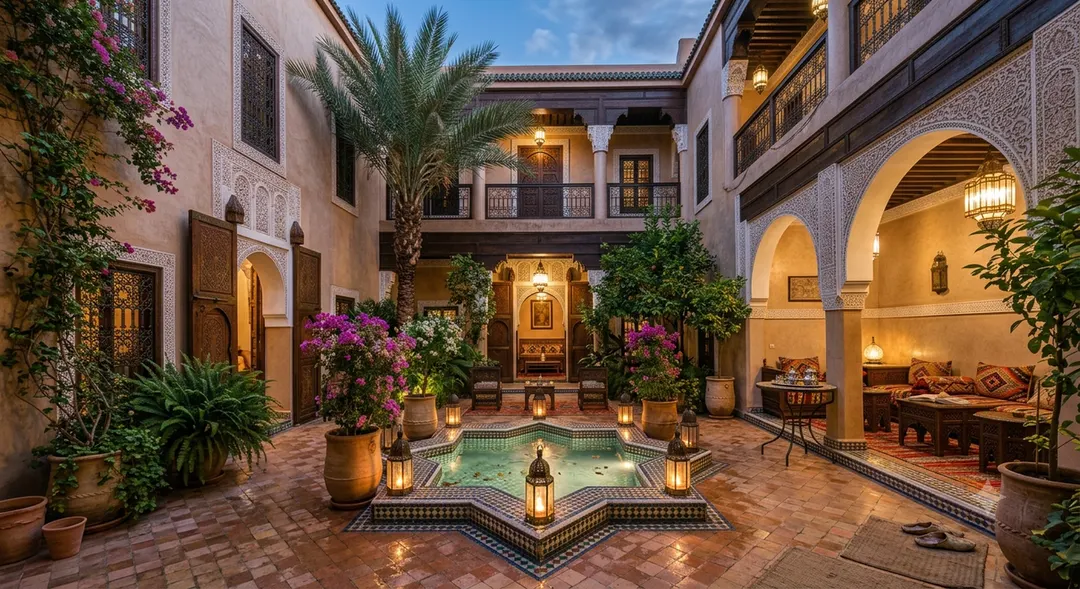
On the operations side, Morocco needs producing. Riads are small and beautiful and were not built for a brigade; the desert is a supply-chain problem; and the standard of the kosher infrastructure varies sharply by city. All of which is exactly the work.
Where, within it
The regions
worth choosing between.
Marrakech
Riads in the medina, villas in the Palmeraie, the mellah and the Slat al-Azama. The usual base, and the easiest to provision.
Fez
The oldest and most intact medina in the Arab world, and the most significant Jewish quarter in the country.
Essaouira & the Atlantic coast
Cool, windy, low-key — and once nearly half Jewish. The best place in Morocco to slow down.
The Atlas & the valleys
Kasbahs, Berber villages, walking, and the Jewish villages of the Anti-Atlas beyond them.
The Sahara
Private desert camps in the Erg Chigaga or Erg Chebbi, produced with a full kitchen brought in.
Casablanca & Rabat
The living community, the Jewish Museum, and the practical base for provisioning the country.
When it's actually good
March–May
The best window. Warm days, cool nights, the Atlas still with snow on it.
October–November
Equally good, with the desert at its most comfortable.
Winter
Marrakech is mild and excellent; the Atlas is cold and the desert nights are genuinely so.
Summer
Very hot inland. Workable only on the Atlantic coast, and we will say so.
How it's produced
The practical
shape of it.
Properties
- Private riads in the Marrakech and Fez medinas, taken whole
- Palmeraie and Atlas-foothill villas with pools and gardens
- Kasbah properties in the southern valleys
- Private desert camps built for the group
- Coastal houses in Essaouira and Oualidia
Culinary
- Moroccan Jewish cooking, which is a distinct cuisine and not a variation on the national one
- Tagines, couscous, pastilla and salads produced within the standard
- Market mornings in the souks with the chef, which children tend to remember
- Desert cooking over fire, with the kitchen brought in and built for the camp
- Mint tea and pastry properly done — a small thing that sets the tone of a stay
Kosher setup & provisioning
- Riad and villa kitchens kashered, or a dedicated mobile kitchen installed
- Provisioning through Casablanca and Marrakech, with the rest brought in
- Desert camps supplied as a self-contained operation with everything carried
- Mashgiach travelling with the group throughout
- Water, refrigeration and power planned for in remote locations
Shabbat, Yom Tov & Jewish life
- The mellahs of Marrakech, Fez, Essaouira and Meknes
- Restored synagogues — Slat al-Azama, Ibn Danan, Beth-El in Casablanca
- Cemeteries and the tombs of the tzadikim, which remain places of pilgrimage
- The living communities of Casablanca and Marrakech, visited with introduction
- Shabbat produced privately, with a minyan formed from the group or with the community
Getting there
- Gateways: Marrakech, Casablanca, Fez, Essaouira, Ouarzazate for the south
- Internal distances are long — the Atlas crossing to the desert is a full day, and we plan it as one
- Drivers and 4×4 vehicles throughout; the southern valleys require them
- Private aviation available into Marrakech and Casablanca
Journey styles in Morocco